Difference between revisions of "Current OPV Research Directions"
Jump to navigation
Jump to search
Cmditradmin (talk | contribs) |
Cmditradmin (talk | contribs) |
||
| Line 9: | Line 9: | ||
== Dendritic Polymers == | == Dendritic Polymers == | ||
[[Image:dendriticpolymer.jpg|thumb|400px|Dendritic polymers create a spiky surface which may be able to be combined with an suitable electron acceptor layer to form a finely organized heterojunction.]] | [[Image:dendriticpolymer.jpg|left|thumb|400px|Dendritic polymers create a spiky surface which may be able to be combined with an suitable electron acceptor layer to form a finely organized heterojunction.]] | ||
<br clear='all'> | <br clear='all'> | ||
Revision as of 14:00, 6 May 2009
Discotic Mesophase Materials
this


Dendritic Polymers

Nanoparticles

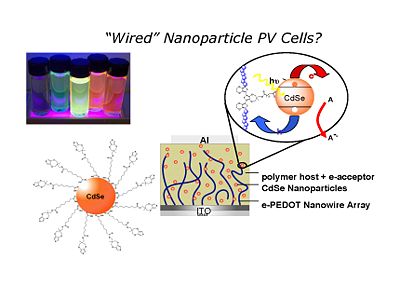
Semiconductor nanoparticles built from cadmium selenide 2-5nm in diameter take on interesting electron properties. The particle is capped with ligands to make them processable. The size of the nanoparticle determines the luminescence. The smallest make blue color, the largest makes the red. Used in a solar cell they absorb in the same color ranges.